
Vidyamandir High School in Tagore Nagar, Vikhroli East, Mumbai, serves nearly 1,000 students from homes where life is genuinely hard, and sits at the edge of a dense settlement. For many of these children, school is more than a place for academic learning. It is a space where they find routine, support and a sense of stability.
When Ms. Trupti Madhukar Kokate, an Assistant Teacher of English and Geography, began teaching grade 9, she noticed that students frequently used abusive language while speaking to one another. For many, these words were not necessarily meant to hurt someone. They had simply become part of their everyday way of speaking.
Ms. Trupti understood that telling students to “stop using bad words” would not be enough. The students themselves needed to understand why it mattered and take responsibility for changing it.
Building the Rules Together
In August 2025, Ms. Trupti had an open conversation with her 44 students. Instead of giving them a ready-made list of rules, she asked them what kind of classroom they wanted to create and how they expected one another to behave.
Together, they created classroom rules and consequences. One of the rules was that a student who used abusive language would have to sit in another classroom.
For some time, the change was visible. However, by November 2025, some students were slipping back into their old habits.
An Idea from Mulyavardhan Training
Ms. Trupti then remembered an activity shared during her Mulyavardhan training by Shri Kumar Patil (Lecturer, Regional Academic Authority, Mumbai). Although Mulyavardhan is designed for students from grades 1 to 8 and Ms. Trupti was teaching grade 9, she felt the idea could still be meaningful for her students.
She asked every student to write down all the abusive words they knew on a piece of paper. She reassured them that she would not read or show their papers to anyone.
Once they had finished, the students folded their papers and placed them in a tray. The papers were then ceremonially burnt as a symbolic act of letting go of harmful language.

The students watched the papers burn.
It was a simple activity, but it gave them a moment to reflect on the language they used and the kind of classroom they wanted to create. At the end, Ms. Trupti asked them to keep an eye on one another and let her know if someone returned to using abusive language.
One Student Who Struggled to Change
Most students responded positively. However, one student, whom we will call Aarav (name changed), continued to use abusive language.
As per the classroom rule, he was asked to sit in another classroom. A few days later, he returned to Ms. Trupti and asked if he could sit in her class again.
She reminded him that they had already discussed the issue, tried counselling, created classroom rules and conducted the activity. But Aarav came back again, and then again.
His persistence made Ms. Trupti realise that he genuinely wanted another chance.
A Second Chance with a Promise
Ms. Trupti decided to give him one more opportunity. This time, she asked him to make a promise to stop using abusive language not only in her classroom, but in school, at home and outside school as well.
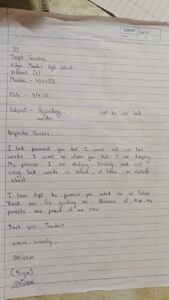
Aarav agreed and wrote a letter to his teacher:
“Ma’am, I had promised you that I would not use bad words. I want to inform you that I am keeping my promise. I am studying sincerely and not using bad words in school, at home, or outside school. I have kept the promise you asked me to follow. Thank you for guiding me. Because of this, my parents are proud of me now. Thank you, Teacher!”
– Aarav, Grade 9, Vidyamandir High School, Vikhroli East, Mumbai
When a Promise Became a Practice
Over the following weeks, Ms. Trupti quietly checked with Aarav and his classmates. They reported that he had kept his promise.
For Ms. Trupti, the purpose was never simply to make a student obey a rule. It was to help him understand his behaviour, take responsibility and make a conscious effort to change.
She continues to keep his letter with her as a reminder of a young student who chose to take responsibility for his own actions.
Mulyavardhan focuses on helping children develop values and social, emotional and ethical competencies through reflection, participation, responsibility and positive relationships. Ms. Trupti’s experience shows how these principles can inspire teachers even beyond the grades in which the programme is directly implemented.
What began as an effort to change the language of a classroom became an opportunity for a child to recognise his behaviour and choose to change it.
For Ms. Trupti, the handwritten letter remains a reminder that sometimes the most meaningful changes in a child’s life begin with something very small: a teacher who believes that a child can do better and gives the child a chance to prove it.