
Sometimes, a child’s answer can reveal much more than what a teacher expects.
At Government Primary School, Mangueshi, (Marathi Medium), Goa, Teacher Ms. Bhagyashree Kholkar discovered this during a Mulyavardhan activity based on emotions in grade 4. What began as a classroom discussion about feelings became a moment that changed the way she understood and responded to her students.
One Question. One Unexpected Answer.
The school has 26 students from grades 1 to 4. Around 80% of them come from the local community, while the remaining students are from migrant families, many of whom work as daily wage labourers.
Ms. Bhagyashree had been teaching for 16 years. She found it particularly challenging to deal with behavioural issues among some of the migrant students. One student, 9-year-old Sameer Yadav (name changed), had joined the school the previous year. He and a friend were often difficult to manage in the classroom.
Then came one Mulyavardhan activity that made her see him differently.
During the activity on emotions for grade 4 students, Ms. Bhagyashree asked:
“If you are feeling hungry and you come home to see your mother preparing your favourite dish, how would you feel?”
Most children quickly answered, “Happy.” But Sameer said, “Sad.” His answer caught the teacher completely off guard.
Behind the Behaviour Was a Story
Ms. Bhagyashree asked Sameer why he would feel sad. His answer stayed with her.
Sameer explained that his mother had never prepared his favourite dish, idli, at home because the family could not afford it. His parents had migrated from Uttar Pradesh to Goa. His father worked as a daily wage labourer, while his mother was a homemaker. Sameer’s younger sibling was enrolled in the local balwadi.
In that moment, Ms. Bhagyashree realised that there was much more to Sameer than the behaviour she had been seeing in her classroom. She was deeply moved. Yet she composed herself and explained to Sameer that we can sometimes experience more than one emotion at the same time. He could feel sad about one thing and happy about another.
Sameer agreed. But for his teacher, the moment had already changed something.
From Correcting Behaviour to Understanding the Child
“Earlier, I used to snap at certain behaviour,” Ms. Bhagyashree recalls. The experience made her pause and look beyond the behaviour.
She began making a conscious effort to understand each child individually, to ask herself why a child might be behaving in a particular way before reacting to it.
Slowly, this changed the way she interacted with her students. She found that understanding their backgrounds, emotions and individual circumstances helped her build stronger relationships with them. It also gave her better ways to address behavioural challenges in the classroom. What she had earlier seen simply as “difficult behaviour” now had a story behind it.
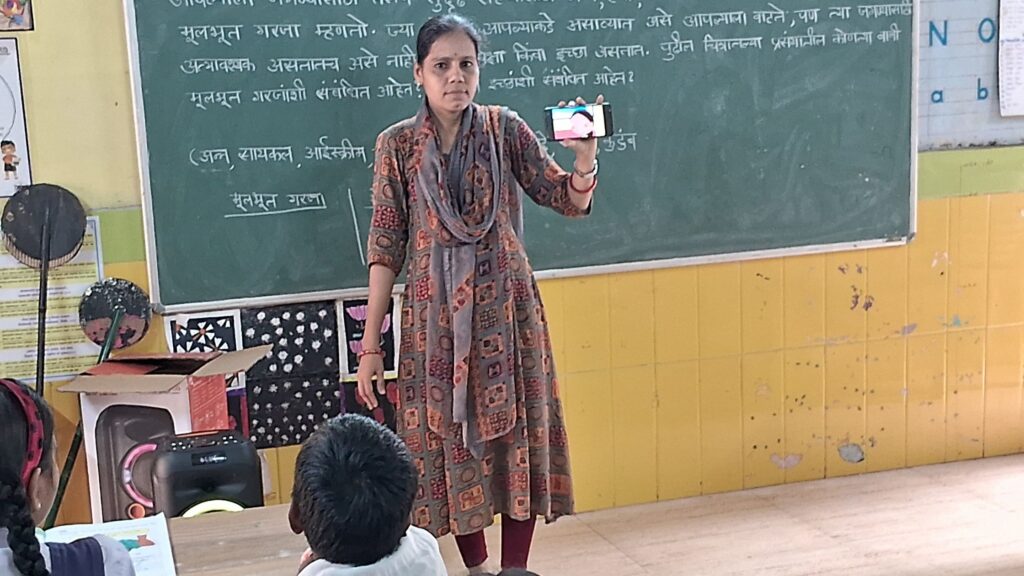
Teacher Ms. Bhagyashree conducting an interactive Mulyavardhan activity with her students
A Lesson in Empathy: For the Teacher Too
For Ms. Bhagyashree, the activity was meant to help children identify and express their emotions. Instead, it taught her something equally important.
“If one is alert enough, one can learn a lot. This activity on emotions actually taught me about empathy.”
She also realised how important it is to give children the freedom to express themselves without fear of being judged. The experience reinforced a simple but powerful belief: every child is different, and every child needs to be understood accordingly.
When a Classroom Activity Creates a Bigger Change
Mulyavardhan activities are designed to give children opportunities to think, express themselves, listen to others and learn together. In Sameer’s case, the activity on emotions did something unexpected: it opened a window into a child’s world.
For Ms. Bhagyashree, it became a reminder that effective classroom management is not only about managing behaviour. Sometimes, it begins with understanding what lies behind it. One question led to one honest answer. That answer changed the way a teacher saw one child. And in doing so, it changed the way she looked at her classroom.
Because when teachers understand children better, classrooms become places where children feel seen, heard and understood.